Research
A key challenge in precision medicine is understanding the drivers of inter-individual variability and how they mediate variability in disease risk and its outcomes. Our lab develops statistical genetics and integrative genomics strategies to improve disease risk stratification and patient outcomes. Our research spans four areas:
1. Polygenic Risk Score × Environment Interactions (PRS×E)
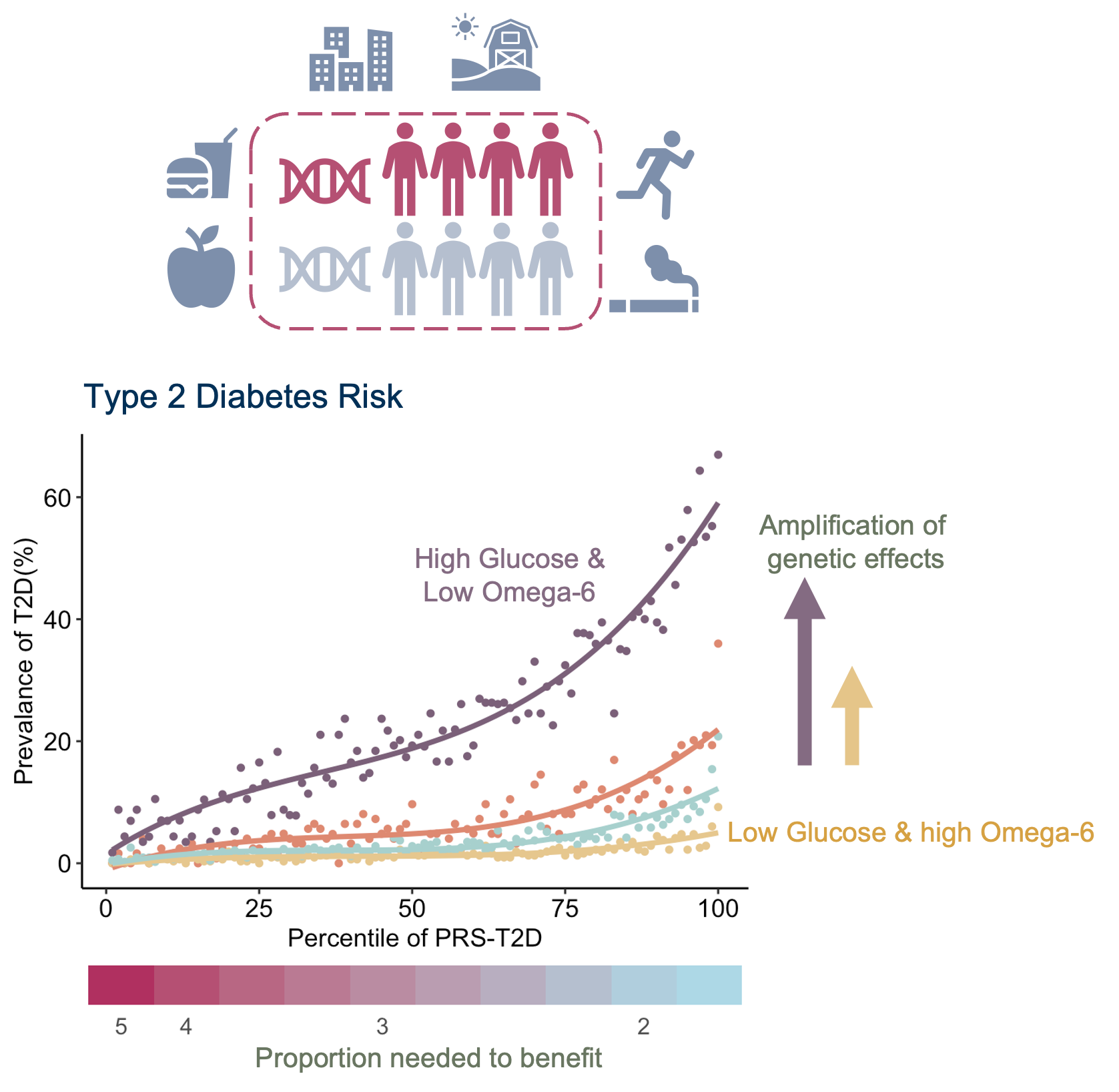
Polygenic risk scores (PRSs) offer significant value in risk stratification rather than overall prediction or diagnosis. When integrated with environmental and clinical risk factors, PRS-based approaches enhance the ability to identify individuals on whom preventative interventions would be most impactful. Our work has demonstrated pervasive evidence of PRSxE interactions influencing common non-communicable diseases, underscoring the context-dependency of PRSs.
Key Publications:
- Sini Nagpal and Greg Gibson. Pervasive Interactions between Exposures and Polygenic Risk can Inform more Effective Clinical and Behavioral Intervention. Nature Genetics (2026).
- Sini Nagpal, Raghav Tandon, Greg Gibson. Canalization of the polygenic risk of common diseases and traits in the UK Biobank. Molecular Biology and Evolution (2022).
- Sini Nagpal, Greg Gibson, Urko M. Marigorta. Pervasive modulation of obesity risk by the environment and genomic background. Genes (2018).
2. Integrative Genomics
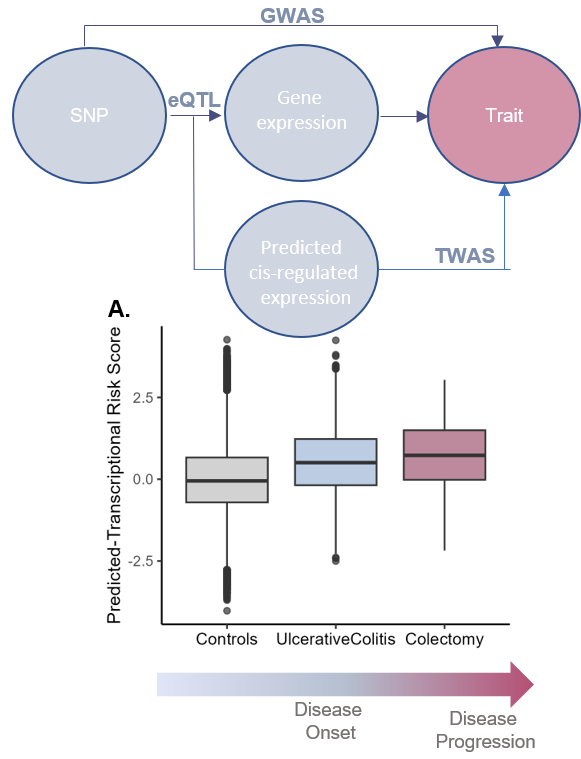
An important goal of clinical genomics is to not only predict disease onset but progression to adverse outcomes, recurrence as well as response to treatments. Integrative genomics enables the integration of genetics with dynamic variables such as transcriptomics and metabolomics to unravel the complexity of common diseases.
Key Publications:
- Kyle Gettler, Sini Nagpal,.....Maria Abreu, Subra Kugathasan, Dermot P. McGovern, Steven R. Brant, Richard H. Duerr, Mark S. Silverberg, John D. Rioux, Greg Gibson, Judy H. Cho. Post-operative ileum transcriptomics implicates sex-biased mechanisms of Crohn's disease recurrence. Gastroenterology (2025).
- Angela Mo*, Sini Nagpal*, Kyle Gettler, Talin Haritunians,.....Dermot P.B. McGovern, Jeffrey S. Hyams, Subra Kugathasan, Judy H. Cho, Lee A. Denson, Greg Gibson. Stratification of risk of progression to colectomy in ulcerative colitis via measured and predicted gene expression. American Journal of Human Genetics (2021). (*Equal contribution)
- Sini Nagpal*, Xiaoran Meng*, Michael P. Epstein, Lam C. Tsoi, Matthew Patrick, Greg Gibson, Philip L. De Jager, David A. Bennett, Aliza P. Wingo, Thomas S. Wingo, Jingjing Yang. TIGAR: An improved Bayesian tool for transcriptomic data imputation enhances gene mapping of complex traits. American Journal of Human Genetics (2019). (*Equal contribution)
3. Monogenic vs Polygenic Risk
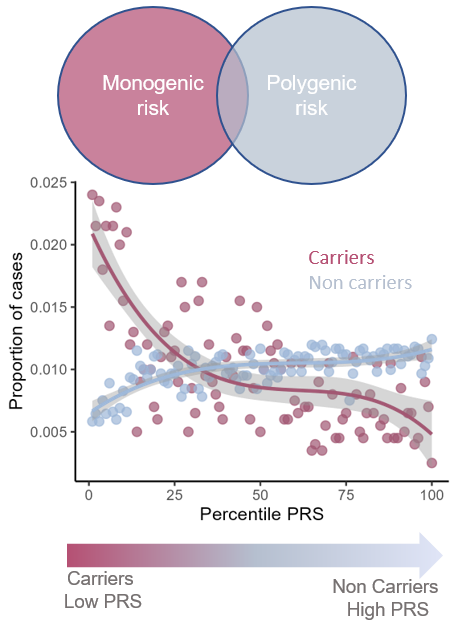
PRSs can identify subgroups of individuals with disease risk comparable to monogenic mutations. While rare pathogenic variants can confer several-fold increased risk, there is often large clinical variability due to incomplete penetrance and variable expressivity. A key question is how monogenic and polygenic risk interact, and whether disease risk from rare pathogenic variants is modulated by the polygenic background. Disentangling rare and common variant contributions has important implications for understanding disease physiology and therapeutic interventions.
Key Publications:
- Sini Nagpal, Kosar Hooshmand, Piyushkumar Mundra, Mandy L. Ballinger, International Sarcoma Kindred Study (ISKS), Greg Gibson, David M. Thomas. A genome-wide association study implicates the glutamate signaling pathway in sarcoma susceptibility. (Under review).
4. Ancestry-Specific Genetic Effects and Health Equity
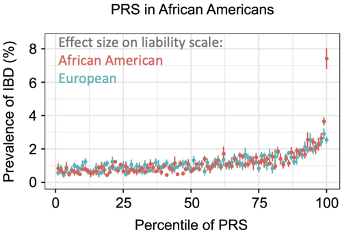
Since genetic studies are largely European-biased, risk predictors are not translatable to individuals of non-European and mixed ancestries, exacerbating health disparities. As we move towards precision medicine, it is vital to include understudied populations in genetic analyses. Our lab studies the differential genetic architecture of diseases across populations and develops ancestry-informed genetic risk assessment approaches.
Key Publications:
- Hari K. Somineni, Sini Nagpal, Suresh Venkateswaran, David J. Cutler,et al. Whole-genome sequencing of African Americans implicates differential genetic architecture in inflammatory bowel disease. American Journal of Human Genetics (2021).
- Courtney Astore, Shivam Sharma, Sini Nagpal, NIDDK IBD Genetics Consortium, David J. Cutler, John D. Rioux, Judy H. Cho, Dermot P.B. McGovern, Steven R. Brant, Subra Kugathasan, I. King Jordan, Greg Gibson. The role of admixture in rare variant contributions to inflammatory bowel disease. Genome Medicine (2023).